GarmentCare Guide
Lift excess dirt and read the care claim
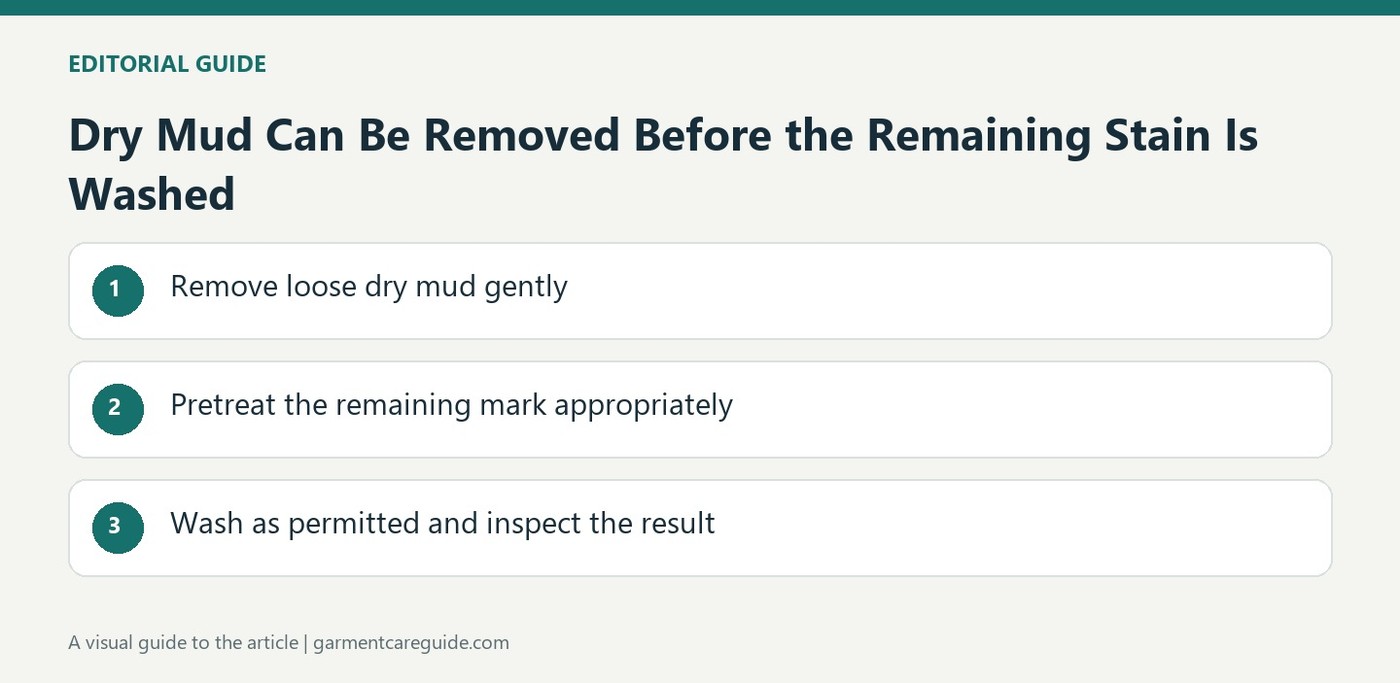
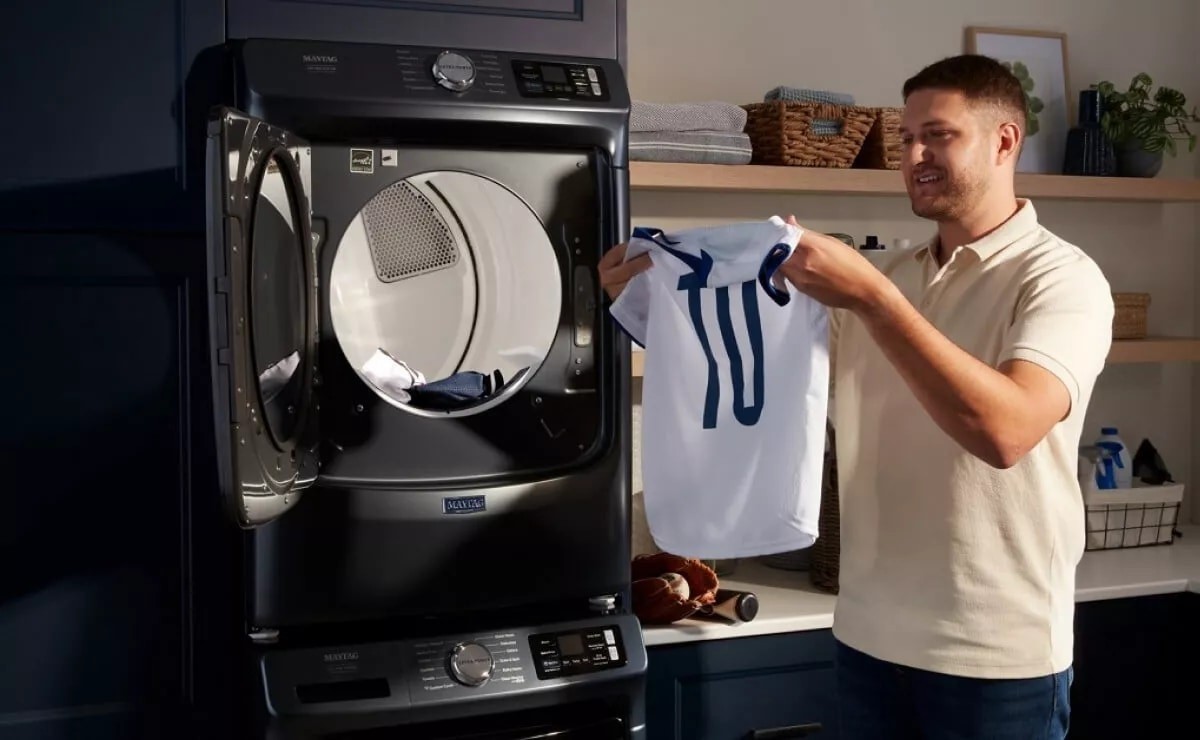
Maytag's mud and dirt guide starts with gently removing excess material, using a suitable spoon edge or card rather than forcefully rubbing it through the fabric. It then discusses a cold rinse for items that permit wet treatment. Read the garment's care information before applying a spot product, and test the chosen method on a discreet area where appropriate. The purpose is to prepare the remaining stain in a controlled way. A large surface deposit and a residual discoloration are different stages of the same cleaning task.
Choose among alternatives rather than stacking them
The source presents several possible approaches, including suitable enzyme cleaner and liquid laundry detergent. Its liquid-detergent example allows a short directed treatment period followed by thorough rinsing. Those methods should be selected according to material and product compatibility, not combined with every other remedy listed on the page. Bleach has its own garment and product restrictions, while an acidic household treatment is not automatically suitable for delicate fabrics or elastic components. A simpler compatible process is easier to assess than repeatedly adding products whose interactions and effects on the textile are uncertain.

Wash appropriately and inspect before drying
Maytag recommends the garment's allowed wash conditions and a check for any stain remaining before the item enters a dryer. Heat can make residue harder to remove, so another suitable treatment may be needed first. Do not infer that a hot wash or dryer cycle is appropriate merely because the fabric still looks dirty. The care claim remains in force throughout the routine. Removing loose dirt, choosing one compatible pretreatment and assessing the result after the permitted wash provides a more precise approach than treating mud as a reason to use every available cleaning product.
Treat the list of methods as alternatives with separate conditions
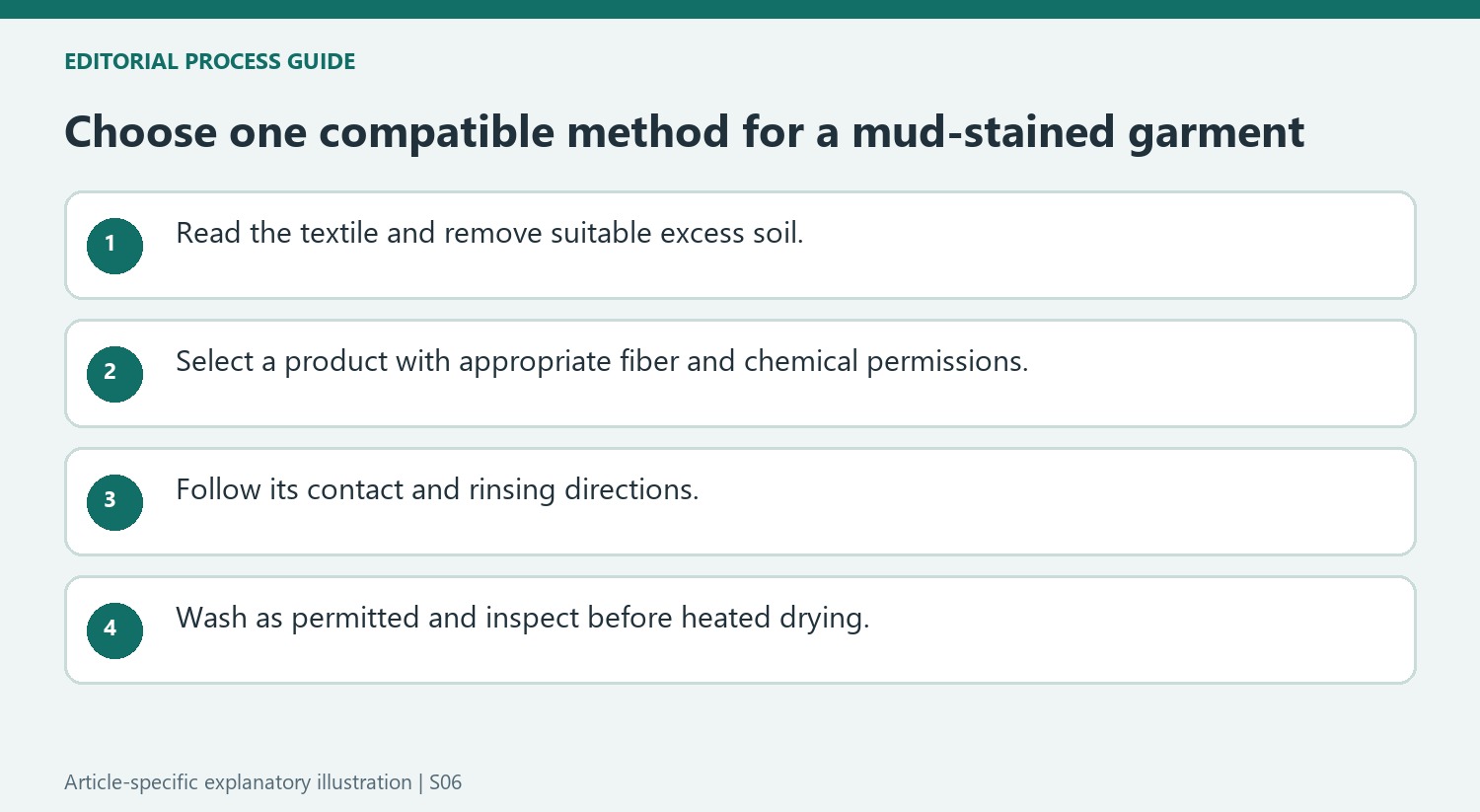
Maytag discusses enzyme cleaner, liquid laundry detergent, and other options for muddy marks. Select among them according to the actual garment and product directions rather than applying the whole list to the same area. The existence of several possible methods does not establish that their combination is appropriate. Start by identifying the material and removing suitable loose dirt, then choose a coherent treatment. Read any contact time and rinsing instruction for that product. If the textile excludes the proposed route, seek an alternative compatible approach instead of assuming dilution or extra rinsing cancels the conflict. A single well-defined method is easier to carry out and assess than repeated additions whose effects on the garment are uncertain.
Chemical permissions remain independent of a muddy appearance
The source notes restrictions around acidic treatments, delicate materials, and elastic components, and treats bleach as conditional on the garment. Keep those distinctions visible. White clothing does not automatically allow chlorine bleach, and a household ingredient is not universally suitable because it is familiar. Read the garment's actual chemical-care information and the chosen product's intended use before preparing a solution. The same caution applies to enzyme formulations: identify whether the product suits the fiber rather than assuming every stain-focused detergent is appropriate. Mud provides the reason for a cleaning task, while the completed textile supplies the boundaries within which that task can be attempted without replacing one mark with damage or a changed finish.
Rinsing and inspection separate the treatment stages
In its liquid-detergent example, Maytag includes thorough rinsing after the directed local treatment. Follow the chosen method's sequence rather than skipping the transition into the main wash. Select permitted machine settings and an appropriate main-wash dose for compatible garments, then examine the affected area before drying. A remaining mark may need another suitable attempt; dryer heat can make later removal more difficult. Natural drying also needs the support specified for the garment. This sequence turns a long advice page into a few clear decisions: reduce loose soil, perform one compatible preparation correctly, wash within the label, and choose the next step from the actual result rather than from a promise of guaranteed removal.